Your API.
One clear
map.
Routes, dependencies, and contracts — mapped like a subway. Understand a codebase before you run it.
Local source analysis. No app startup. No code upload.
Select a station to see its connections
auth Orders service database
Read the routes
Method, path, and source location.
Trace dependencies
Middleware, services, and integrations.
Explore contracts
Request and response fields.
Less searching.
More
understanding.
-
Understand unfamiliar APIs
See the routes and the dependencies they share.
-
Debug contracts locally
Edit requests and inspect related responses in one shared sandbox.
-
Review changes before merge
Compare API maps, detect code/spec drift, and inspect consumer impact.
Works with your stack
Express · Next.js · FastAPI · Fastify · Hono · NestJS · Django REST · Flask · Spring Boot · ASP.NET Core · Go · OpenAPI
A real map.
A working sandbox.
Explore the committed commerce API demo.
Open the demo to edit requests and see the shared local data change.
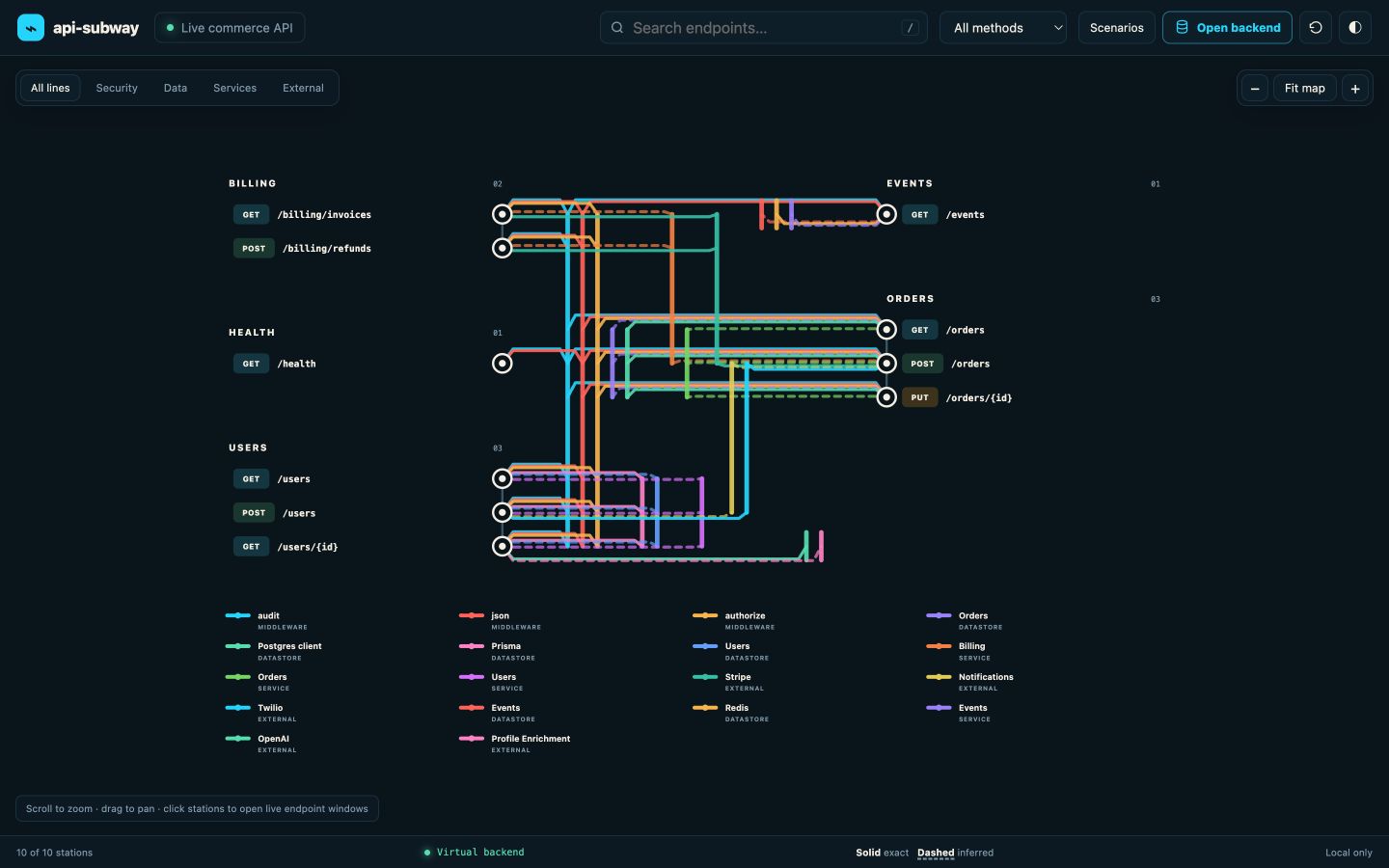
This demo simulates contracts in your browser. It does not call a real server or execute application code.
Map your own
codebase.
One command. Portable artifacts you can share and review.
- SVG map
- Visual API map
- Interactive HTML
- Browse and explore
- JSON model
- Optional machine-readable data
- OpenAPI 3.1
- Optional API specification
# Generate your API map
npx api-subway generate . --out docs/api-subway
# Keep your map current in CI
npx api-subway check . --out docs/api-subway